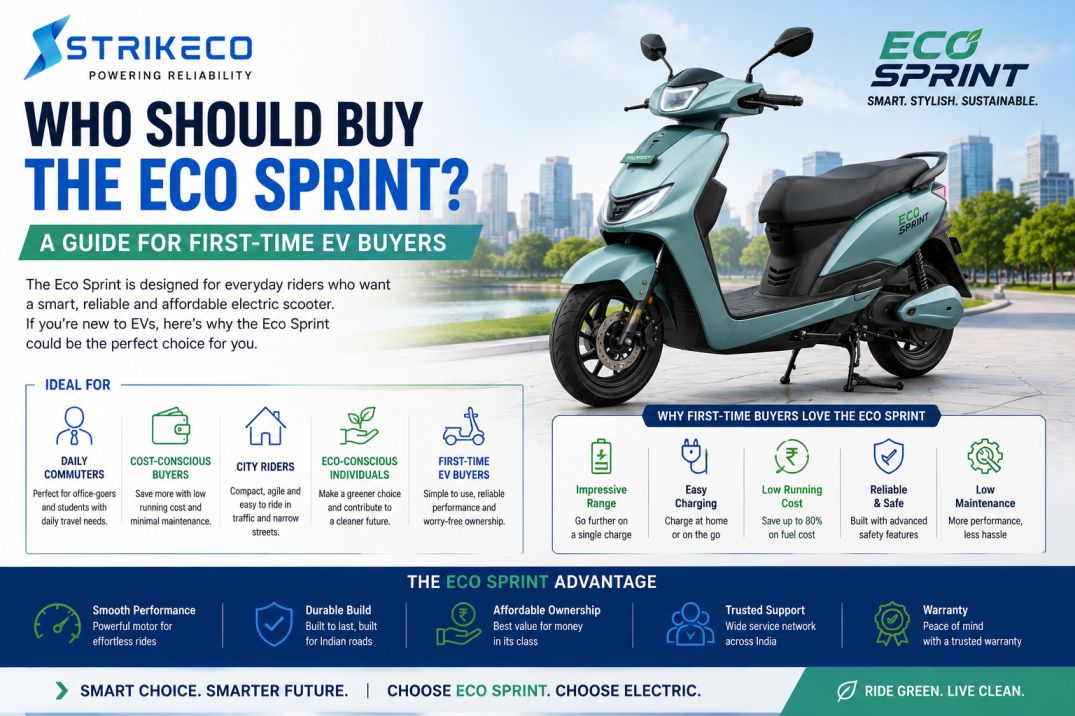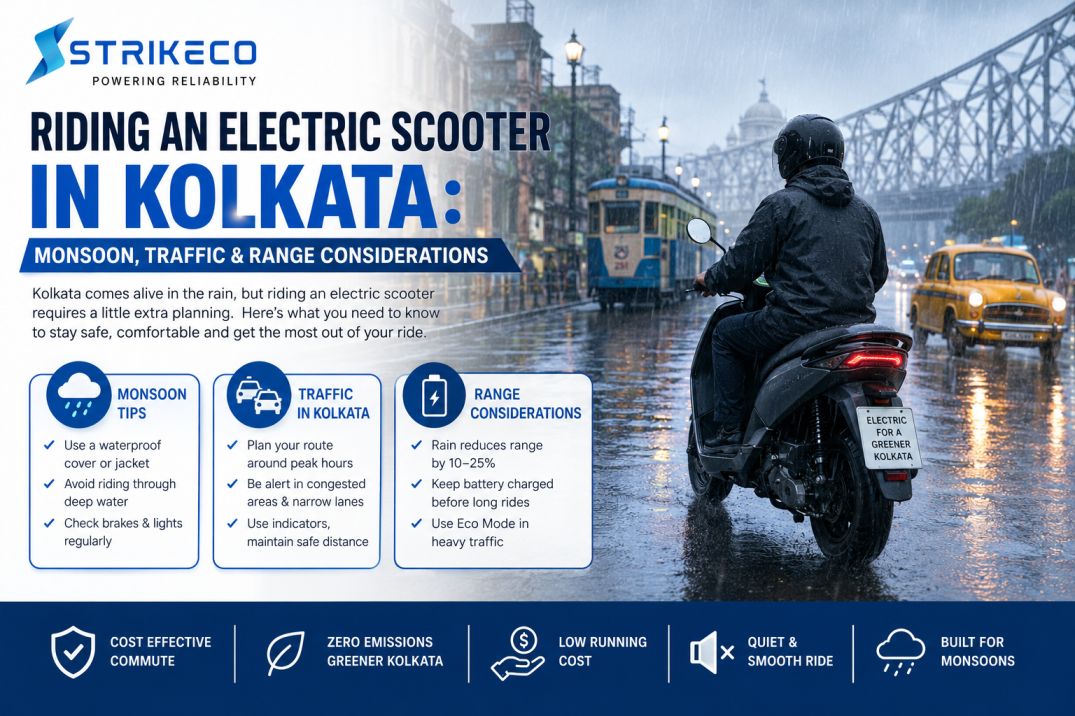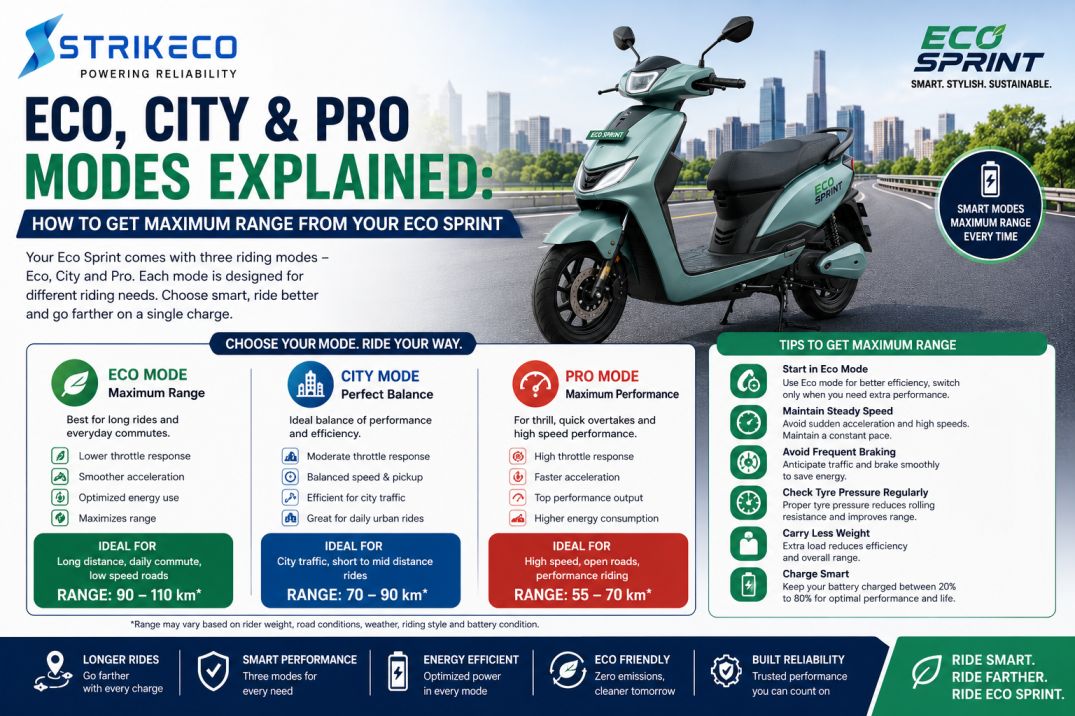
The Eco Sprint’s Eco, City, and Pro riding modes are designed to change how the scooter delivers power for different riding situations. In simple terms, Eco mode prioritizes efficiency and range, City mode balances performance and battery consumption, while Pro mode gives stronger acceleration and performance when needed.
StrikeCo describes the Eco Sprint as an entry-level commuter scooter with Eco, City, and Pro ride modes, allowing riders to prioritize range on longer days or stronger acceleration in denser traffic.
For riders who want to maximize range, the key is not to stay in one mode all the time. Better results usually come from combining the right riding mode with smooth acceleration, moderate speeds, correct tyre pressure, sensible loading, and efficient braking habits.
What Are Eco, City, and Pro Riding Modes in an Electric Scooter?
Riding modes change how an electric scooter responds to throttle input and how aggressively power is delivered from the battery to the motor. Eco mode generally limits performance to save energy, City mode provides a balance between efficiency and responsiveness, and Pro mode prioritizes stronger acceleration and higher performance.
On an electric scooter, the controller regulates how much electrical power is sent to the motor. Different riding modes can alter this behaviour.
A simplified comparison looks like this:
Riding Mode
Main Priority
Best Used For
Eco
Maximum efficiency
Longer commutes, range conservation
City
Balance of range and performance
Regular urban commuting
Pro
Stronger performance
Faster acceleration, overtaking, demanding traffic
The actual speed, acceleration and power limits depend on the scooter’s programming, battery condition and operating conditions.
The Eco Sprint is specifically positioned as a daily commuter with these three riding modes, allowing riders to adapt performance according to traffic and range requirements.
What Is the Difference Between Eco, City, and Pro Modes on the Eco Sprint?
The main difference is how aggressively the scooter delivers power. Eco mode is best when conserving battery is the priority, City mode is suited to normal urban traffic, and Pro mode is useful when quicker acceleration or stronger response is required.
Eco Mode
Eco mode should be your first choice when you want to extend the distance available from a charge.
It is especially useful for:
Longer daily commutes
Low-to-moderate speed roads
Heavy traffic where high performance is unnecessary
Riding when the battery percentage is lower
Days when you need additional range for errands
Eco mode can help reduce unnecessary energy consumption by encouraging more moderate power delivery.
City Mode
City mode is generally the most practical option for everyday urban commuting because it balances efficiency with responsiveness.
It is useful when you need enough acceleration to move through normal city traffic while still keeping battery consumption under control.
For many Eco Sprint owners, City mode may become the default mode for everyday office, college or local commuting.
Pro Mode
Pro mode prioritizes performance.
It may be useful when:
Joining faster-moving traffic
Overtaking where safe and legal
Carrying additional load
Riding on sections where stronger acceleration is useful
However, using stronger acceleration frequently generally consumes more energy and can reduce total range compared with gentler riding.
The U.S. Department of Energy notes that rapid acceleration reduces EV driving range compared with gradual acceleration.
Which Riding Mode Gives the Maximum Range?
Eco mode is generally the most suitable mode when maximum range is your main objective because it prioritizes efficient power delivery rather than peak performance. However, riding style, traffic, speed, rider weight, tyre pressure and weather can influence range just as much as the selected mode.
Think of riding mode as only one part of the efficiency equation.
A rider using Eco mode but repeatedly accelerating hard may consume more battery than another rider using City mode smoothly.
Similarly, a rider carrying a passenger with underinflated tyres may see significantly different range from a solo rider on the same scooter.
Therefore:
Mode + speed + acceleration + load + road conditions + tyres + weather = real-world range
This is why advertised range should not be treated as a guaranteed number for every rider.
StrikeCo itself notes that real-world electric scooter range can vary substantially from certified figures depending on rider, traffic, load, terrain and weather.
When Should You Use Eco, City, or Pro Mode During Daily Commuting?
A practical approach is to switch modes according to the road rather than using Pro mode throughout the entire journey.
For example, imagine a 25 km daily commute.
You begin in a residential area where speeds are low. Eco mode is sufficient.
You then enter normal city traffic. Switching to City mode gives more responsive acceleration without prioritizing maximum performance.
On a short section where quicker acceleration is useful, Pro mode may be appropriate.
Once traffic slows again, returning to City or Eco mode can help conserve energy.
This type of mode management is especially useful on days when your commute includes additional errands.
Instead of thinking:
“Which mode is best?”
think:
“Which mode is appropriate for this part of my journey?”
How Does Riding Speed Affect Electric Scooter Range?
Higher sustained speeds generally increase energy consumption because the motor must work harder and aerodynamic resistance increases significantly with speed. Moderate, steady speeds are usually more efficient than repeatedly accelerating to higher speeds and slowing again.
This effect can be substantial.
The U.S. Department of Energy explains that EVs typically use more energy during highway-type higher-speed travel because additional energy is required to overcome increased aerodynamic drag.
For an electric scooter, this means continuously riding at or near maximum performance generally consumes battery faster than moderate urban speeds.
You do not necessarily need to ride extremely slowly.
The goal is to avoid unnecessarily high speeds when they provide little practical benefit.
If you accelerate aggressively only to reach the next traffic signal a few seconds earlier, you have used additional battery without significantly reducing travel time.
How Does Acceleration Affect Battery Consumption?
Acceleration requires the motor to draw more power.
Smooth acceleration therefore helps conserve battery.
Compare two Eco Sprint riders travelling the same 20 km route.
Rider A: Accelerates gradually, anticipates signals and maintains steady speed.
Rider B: Uses full throttle after every signal and brakes heavily before the next one.
Rider B is likely to use more battery despite travelling exactly the same distance.
The U.S. Department of Energy specifically identifies rapid acceleration as a factor that can reduce electric vehicle range.
For better range, increase throttle progressively instead of repeatedly demanding maximum acceleration.
How Do Traffic and Stop-and-Go Riding Affect Eco Sprint Range?
Traffic can have both positive and negative effects on an EV.
Electric vehicles can be efficient at lower urban speeds, and regenerative braking can recover some otherwise-lost kinetic energy. The U.S. Department of Energy notes that frequent stops in city driving can increase opportunities for regenerative braking.
However, repeated aggressive acceleration still consumes energy.
A useful traffic strategy is:
Look ahead → release the throttle early → slow progressively → avoid unnecessary acceleration → use regenerative braking where available
This reduces the amount of energy wasted between closely spaced signals and traffic queues.
How Does Rider Weight Affect Range?
Additional rider, passenger and luggage weight generally increases energy consumption because the motor has to move greater mass, particularly during acceleration and climbing.
A solo rider weighing 65 kg may therefore experience different range from someone carrying:
a heavier rider,
a pillion,
luggage,
or a combination of all three.
Weight differences may be less noticeable when travelling at a constant speed on flat roads but become more important in stop-and-go traffic because the scooter repeatedly has to accelerate the additional mass.
If you regularly ride with a pillion, assess real-world range under that condition rather than relying on solo-rider figures.
How Do Road Conditions Affect Battery Range?
Rough roads, repeated braking, steep inclines and poor surfaces can all affect energy consumption.
On smooth roads, you can maintain a relatively consistent speed.
On broken or congested roads, you may repeatedly accelerate, brake and change direction.
Inclines require additional power because the scooter has to work against gravity.
StrikeCo notes that factors such as terrain and heavy load can widen the difference between certified range and real-world range.
When planning your required range, use your actual route rather than simply calculating the straight-line distance between home and office.
Why Does Tyre Pressure Matter for Electric Scooter Range?
Incorrect tyre pressure can increase rolling resistance, which means the motor must use additional energy to keep the scooter moving. Maintaining the manufacturer-recommended tyre pressure can therefore support both efficiency and predictable handling.
Tyres should not be overinflated simply to chase additional range.
Follow the manufacturer's specified cold tyre pressure.
Official U.S. Department of Energy EV range-test procedures similarly require tyres to be adjusted to manufacturer-recommended pressure before range testing.
Checking tyre pressure regularly is one of the simplest range-maintenance habits an EV owner can adopt.
How Does Weather Affect Eco Sprint Range?
Battery performance and energy consumption can change with ambient temperature. Very hot conditions can increase thermal stress, while environmental conditions can also affect battery efficiency, tyres, motor temperature and riding behaviour.
StrikeCo notes that prolonged high-temperature exposure can contribute to battery degradation and that riders in very hot climates should pay attention to charging and storage conditions.
For everyday ownership:
Avoid leaving the scooter unnecessarily exposed to extreme heat for long periods when shaded parking is available.
Follow manufacturer guidance concerning charging temperature.
Avoid charging immediately after unusually demanding riding if the manufacturer recommends allowing the battery to cool.
During rain, prioritise traction and safety rather than trying to maximize range.
Range efficiency should never come before safe riding.
How Can Regenerative Braking Increase Electric Scooter Range?
Regenerative braking converts part of the vehicle’s kinetic energy back into electrical energy during deceleration instead of losing all of that energy as heat through conventional braking. Where the Eco Sprint’s configuration supports regenerative braking, smooth deceleration can help recover some energy during urban riding.
Regeneration does not recover all the energy used to accelerate.
However, it can improve overall efficiency.
The U.S. Department of Energy reports that regenerative braking can recover a meaningful portion of energy in electric vehicles, with one combined EPA city/highway analysis estimating net regenerative recovery around 22% for typical EVs. This figure refers to passenger EVs and should not be interpreted as an Eco Sprint-specific recovery percentage.
The principle is still useful for scooter riders:
Instead of staying on the throttle until the last moment and then braking sharply, look ahead and begin slowing earlier.
This gives regenerative systems more opportunity to recover energy where available.
Efficient Braking vs Aggressive Braking
Imagine approaching a red signal.
Method 1: Continue accelerating, then apply hard brakes near the signal.
Method 2: Release the throttle earlier and allow the scooter to decelerate progressively.
The second method generally reduces unnecessary energy use and can make better use of regeneration where supported.
It also creates a smoother riding experience.
However, regenerative braking should never replace proper use of the scooter’s physical brakes when stopping quickly is necessary.
What Are the Best Ways to Maximize Eco Sprint Range?
Getting maximum range does not require constantly monitoring every watt of battery consumption. A few repeatable riding habits have a much bigger effect.
First, use Eco mode when strong acceleration is unnecessary, particularly on longer journeys.
Second, accelerate gradually rather than immediately applying maximum throttle.
Third, maintain a steady moderate speed instead of repeatedly accelerating and braking.
Fourth, anticipate traffic. Releasing the throttle early can reduce wasted energy.
Fifth, keep the scooter’s tyres at the manufacturer-recommended pressure.
Sixth, remove unnecessary heavy loads when they are not required.
Seventh, avoid spending most of the ride in Pro mode if your goal is maximum range.
Eighth, keep the battery and scooter properly maintained and follow recommended charging practices.
Finally, plan your journey with a range reserve rather than trying to reach your destination at almost 0% battery.
A Practical Eco Sprint Range Strategy
Suppose your normal commute is 35 km per day, but twice a week you travel an additional 10 km.
Instead of using Pro mode throughout the entire journey, you could use:
Residential roads: Eco
Normal urban roads: City
Short higher-performance sections: Pro
Heavy traffic: Eco or City depending on responsiveness needed
At the same time:
Keep tyre pressure correct.
Ride smoothly.
Avoid carrying unnecessary luggage.
Anticipate signals.
Use regenerative deceleration where available.
This combination is usually more useful than simply switching to Eco mode and expecting maximum range automatically.
Eco Sprint Range Checklist
Before every longer journey, check the battery level, expected total kilometres, tyre condition and pressure, passenger or luggage load, weather and road conditions. During the ride, use Eco mode where practical, accelerate progressively, maintain a moderate speed, anticipate traffic, avoid unnecessary full-throttle starts and use smooth deceleration.
You can review current model information on the Eco Sprint / Sprint page and explore other StrikeCo electric scooters if your daily range or performance requirement exceeds what an entry-level commuter model provides.
The Eco Sprint’s Eco, City and Pro modes allow riders to balance efficiency and performance according to their journey.
The simplest way to think about them is:
Eco = prioritize range
City = balance range and everyday performance
Pro = prioritize stronger performance
For maximum range, however, riding mode is only part of the answer.
Actual electric scooter range depends on speed, acceleration, traffic, rider weight, terrain, tyre pressure, battery condition, weather and riding habits. StrikeCo’s own guidance highlights these variables when explaining why real-world EV range can differ from certification figures.
A practical range-maximizing strategy is therefore:
Use Eco strategically → accelerate smoothly → maintain moderate speed → anticipate traffic → use regenerative braking efficiently → maintain correct tyre pressure → minimise unnecessary load → follow good battery-charging practices.
Used together, these habits can help Eco Sprint owners make better use of every charge without turning everyday commuting into a range-anxiety exercise.
For an independent explanation of how driving speed, acceleration, load and regenerative braking affect electric-vehicle efficiency, the U.S. Department of Energy’s Alternative Fuels Data Center offers a useful overview. DOE guide to electric vehicle efficiency and range
Frequently Asked Questions
Which Eco Sprint mode gives the best range?
Eco mode is generally the most appropriate choice when conserving battery is the priority because it emphasizes efficiency over maximum performance. Actual range will still vary with speed, rider weight, traffic, road conditions, tyres and weather.
Should I always ride in Eco mode?
Not necessarily. Eco mode is useful for maximizing range, but City mode may provide a better balance during normal traffic. Pro mode can be useful when stronger acceleration is needed. Using the appropriate mode for each part of the journey is often more practical.
Does Pro mode reduce electric scooter range?
Frequent use of higher-performance settings can increase battery consumption, particularly if it encourages stronger acceleration and higher speeds. The actual difference will depend on route and riding style.
Does riding slowly always increase range?
Moderate speeds generally support better efficiency than continuous high-speed riding, but extremely slow riding is not required. Smooth, steady riding is usually more important than chasing the lowest possible speed.
Does carrying a passenger reduce Eco Sprint range?
It can. Additional weight requires more energy, especially during repeated acceleration and climbing. Riders who frequently carry a pillion should assess range under loaded conditions.
Can regenerative braking fully recharge the battery while riding?
No. Regenerative braking only recovers part of the energy that would otherwise be lost during deceleration. It can improve efficiency but cannot replace external charging.
How often should I check tyre pressure for maximum range?
Check it regularly and particularly before longer journeys. Always use the pressure recommended by the scooter manufacturer rather than overinflating the tyres for perceived efficiency gains.
Why is my Eco Sprint range different from the advertised figure?
Real-world range can vary because of speed, acceleration, rider weight, traffic, tyre pressure, road gradient, weather, battery condition and other operating conditions. Certified or claimed range is measured under defined test conditions and should be treated as a comparison reference rather than a guarantee for every trip.