Buying your first electric scooter can feel more complicated than buying a petrol scooter because you need to think about battery range, charging, battery life, real-world riding conditions, service support, and running costs—not just engine size or fuel efficiency.
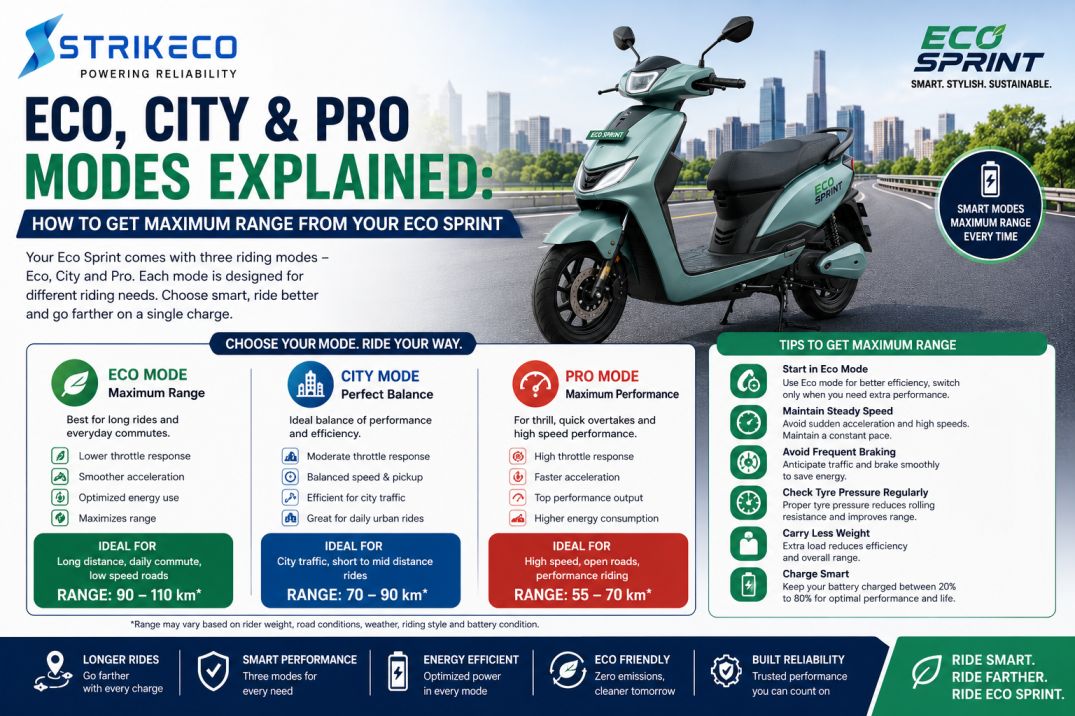
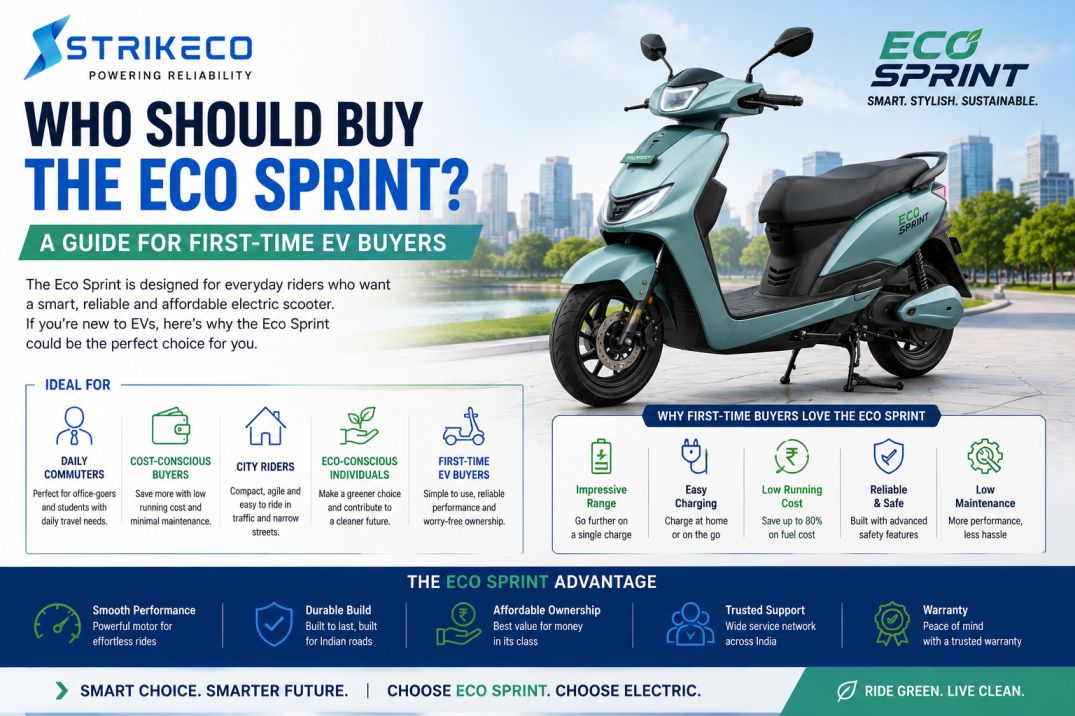
The Eco Sprint is best suited to first-time EV buyers who primarily need a practical scooter for daily city commuting, office trips, college travel, local errands, and other moderate-distance urban journeys. StrikeCo positions the Eco Sprint as an entry-level commuter model aimed at straightforward daily city use, with Eco, City, and Pro riding modes for different riding conditions.
However, whether it is right for you depends on a simple question: Does its battery, range, charging setup, performance, and ownership experience match your actual daily routine?
This guide explains how first-time EV buyers can answer that question.
Who Is the Eco Sprint Electric Scooter Best Suited For?
The Eco Sprint is primarily suited to riders looking for a straightforward electric scooter for regular urban travel rather than very long-distance or heavy-duty use. It can make sense for office commuters, students, local business users, and riders whose daily travel can comfortably fit within the scooter’s practical range.
StrikeCo describes the Eco Sprint as its entry-level commuter model designed for moderate daily distances and home charging. The company also identifies daily office trips, college commuting, and local errands as use cases for the model.
Typical buyers could therefore include:
An employee travelling between home and office every day
A college student making predictable daily trips
Someone replacing a petrol scooter mainly used within the city
A family needing a second vehicle for local errands
A rider who can charge the scooter overnight at home
A first-time EV owner who prefers a simple commuting-focused model
By contrast, someone regularly travelling very long distances, carrying heavy loads, or frequently riding with a pillion may need to compare the Eco Sprint with higher-capacity models before deciding.
Is the Eco Sprint a Good Electric Scooter for First-Time EV Buyers?
It can be a practical option for first-time EV buyers whose priority is routine city commuting and who have reliable home charging. The important step is to evaluate its actual specifications against your needs rather than assuming that an entry-level EV will suit every rider.
First-time buyers often worry about changing from petrol to electric. In day-to-day use, however, the biggest behavioural change is usually charging.
Instead of visiting a petrol station when fuel runs low, an EV rider typically develops a routine of plugging in the scooter at home when needed.
StrikeCo specifically describes the Eco Sprint around this kind of usage: moderate city travel and overnight home charging.
A first-time buyer should be comfortable answering four questions before purchasing:
How many kilometres do I normally travel each day?
Where will I charge the scooter?
Can the scooter comfortably complete my daily journey with range remaining?
Is service support available where I live?
If the answers are clear, transitioning from petrol to electric becomes much easier.
Is the Eco Sprint Suitable for Office, College and Short-Distance City Commuting?
Yes, city commuting is one of the intended use cases for the Eco Sprint. It is particularly relevant for riders travelling predictable distances for work, college, shopping, and local errands rather than relying on the scooter for frequent long-distance travel.
Consider three examples.
Office Commuter
Suppose your office is 10 km from home.
Your normal round trip is:
10 km × 2 = 20 km per day
Add another 5–10 km occasionally for shopping or other errands and your realistic daily requirement may be around 25–30 km.
That kind of predictable usage makes it easier to choose an EV because you know approximately how much range you require each day.
College Student
A student travelling 7 km to college and 7 km back covers:
14 km per day
Even after local trips, the daily distance may remain moderate. Charging overnight can then become part of the normal routine.
Short Urban Errands
For someone mainly using the scooter for:
grocery shopping, nearby offices, railway or metro connectivity, classes, appointments, or local business visits,
daily travel can be significantly lower than the maximum distance the scooter is capable of covering.
For these buyers, factors such as easy handling, charging convenience and operating cost can matter more than chasing the largest possible battery.
What Range Should First-Time EV Buyers Consider?
Your required EV range should comfortably exceed your normal daily travel rather than merely matching it. Always keep additional capacity for detours, traffic, passenger weight, riding style, weather, battery aging, and unexpected trips.
One common first-time EV mistake is choosing a scooter based purely on its advertised range.
Suppose your daily commute is 35 km and a scooter advertises a range of 40 km.
That appears sufficient on paper—but it leaves almost no margin.
Real-world range can vary substantially from certified or advertised figures. StrikeCo itself notes that rider weight, temperature, riding style, traffic conditions, auxiliary loads, and other variables can change actual range. Its published guidance suggests that real-world range can be lower than controlled test figures.
A better approach is:
Daily distance + realistic buffer = minimum practical range requirement
For example:
Typical Daily Travel
What to Look For
10–20 km
Moderate range can be sufficient
20–35 km
Ensure comfortable reserve after commuting
35–50 km
Real-world range becomes a major buying criterion
50 km+
Compare higher-range models and charging options carefully
These are planning guidelines rather than fixed rules.
If your usage is consistently on the higher side, compare the Eco Sprint with other StrikeCo scooters such as the Cresta or Verv based on their current specifications.
What Should First-Time Buyers Know About Charging an Electric Scooter at Home?
Home charging is usually one of the biggest conveniences of electric scooter ownership, but buyers should confirm charging time, charger requirements, socket availability, battery configuration, electrical safety, and whether the charging location remains dry and accessible.
Before purchasing, decide exactly where you will charge.
Ask yourself:
Can I park near an electrical socket?
Can the charger safely reach the scooter without unsafe extension wiring?
Is the charging location protected from rain?
Is the battery removable if I live in an apartment?
How many hours does a normal charge require?
Can the scooter comfortably recharge overnight?
If you live in an apartment without a charging point in the parking area, charging convenience can become more important than small differences in range or price.
The manufacturer's instructions should also be followed regarding charging temperature, charger compatibility and battery care. Avoid using third-party chargers simply because the plug appears compatible.
How Do Electric Scooter Running Costs Compare With a Petrol Scooter?
Electric scooters generally have lower energy costs per kilometre and fewer routine drivetrain maintenance requirements than petrol scooters. However, total ownership cost should also include battery replacement, tyres, brakes, insurance, service, electricity costs, and the original purchase price.
StrikeCo currently uses an illustrative comparison on its website showing approximately ₹4 per km for a petrol scooter versus ₹0.23 per km for a StrikeCo EV, based on the assumptions used in its savings calculator. The company also lists lower illustrative maintenance expenditure for its EV calculation. These figures should be treated as examples because actual petrol prices, electricity tariffs, mileage and service costs vary between owners.
Consider a simple example using those illustrative figures.
If someone rides 30 km per day for 300 days:
Annual distance:
30 × 300 = 9,000 km
At ₹4/km for petrol:
9,000 × ₹4 = ₹36,000
At ₹0.23/km for electricity:
9,000 × ₹0.23 = ₹2,070
This produces a large theoretical operating-cost difference.
Actual savings will depend on your petrol scooter’s mileage, local fuel price, electricity tariff, battery efficiency and charging losses.
India's NITI Aayog e-AMRIT platform also highlights lower energy and operating costs as an important component of EV total-cost-of-ownership comparisons.
The key is to compare total ownership cost, not electricity cost alone.
What Maintenance Should First-Time EV Owners Expect?
Electric scooters eliminate several components associated with an internal-combustion engine. There is no engine oil to change, for example, and the electric drivetrain generally contains fewer moving parts.
That does not mean an EV is maintenance-free.
You still need to monitor:
Tyres: pressure, tread and damage.
Brakes: pads, discs/drums and adjustment.
Suspension: particularly if riding regularly on uneven roads.
Electrical connectors: inspect where recommended by the manufacturer.
Battery: follow correct charging and storage practices.
Charger: protect it from heat, moisture and physical damage.
Software/electronics: some vehicles may require diagnostic checks or updates.
Before buying, ask the dealer about the recommended service intervals and what is covered under warranty.
What Battery, Range and Charging Features Should First-Time Buyers Check?
First-time EV buyers should confirm battery type and capacity, realistic range, battery warranty, charging time, charger specifications, battery-management protection, replacement cost, and what happens to range as the battery ages.
Do not stop at asking:
“How many kilometres will it run?”
Instead ask:
What range is quoted under test conditions?
What can I reasonably expect during city use?
Does carrying a passenger reduce range significantly?
What battery technology is used?
What is the battery warranty?
What conditions can invalidate that warranty?
How long does charging take?
What charger is supplied?
What is the estimated battery-replacement cost?
These questions give you a much better picture of long-term ownership.
What Safety and Practical Features Should You Check?
For a first scooter, everyday usability can matter more than headline specifications.
Compare:
Feature
Why It Matters
Braking system
Important in city traffic
Tyres
Grip and replacement availability
Lighting
Night and low-visibility riding
Ground clearance
Useful on uneven roads
Load capacity
Important for pillion/luggage use
Riding modes
Allows different performance characteristics
Battery protection
Important for battery safety
Water-resistance information
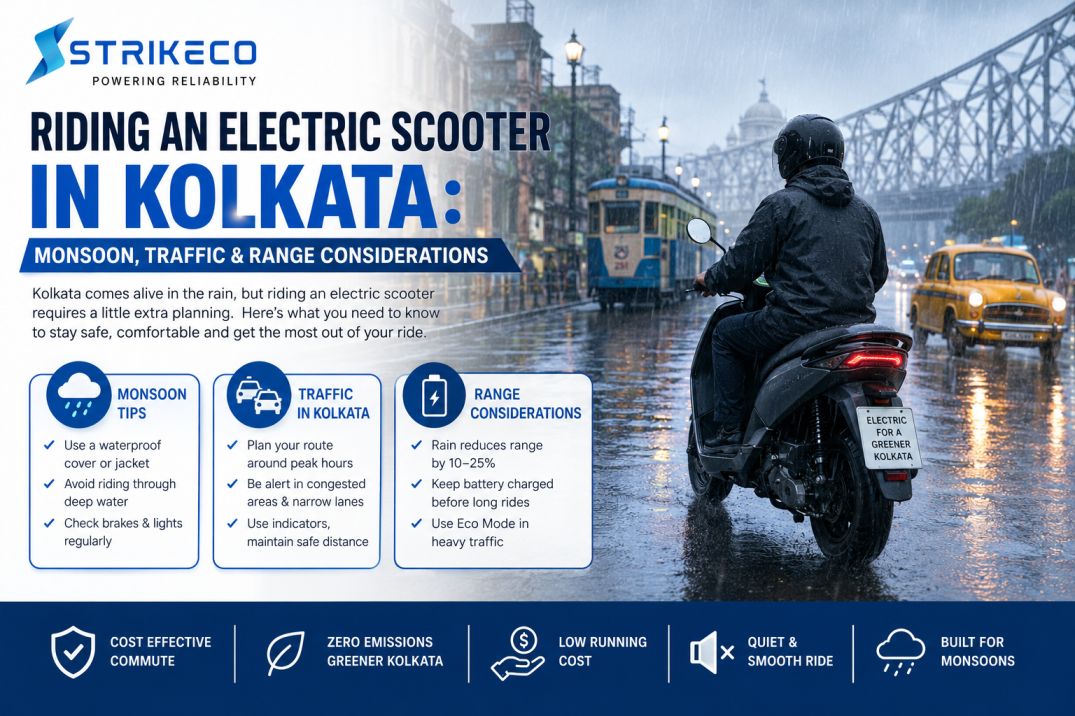
Relevant during monsoon
Display
Battery, speed and riding information
Storage
Helpful for everyday commuting
Seat comfort
Important for longer city journeys
Service availability
Critical after purchase
StrikeCo states that the Eco Sprint includes Eco, City and Pro ride modes, giving riders different options depending on the type of city riding they are doing.
During a test ride, try more than straight-line acceleration. Check low-speed balance, turning radius, braking feel, seating position and visibility of the instrument display.
Should You Choose Eco Sprint or a Higher-Capacity Electric Scooter?
Eco Sprint is more likely to suit buyers prioritising straightforward city commuting, while someone regularly covering longer distances, carrying heavier loads or needing more performance should compare it with higher-capacity alternatives before buying.
For example, StrikeCo's current website lists the Cresta with an 80–90 km range, 2,000W motor, 72V battery and 250 kg load capacity.
That does not automatically make Cresta a better scooter.
A higher-capacity scooter may also involve a different purchase price, weight and ownership profile.
The correct question is not:
“Which StrikeCo scooter has the biggest specifications?”
It is:
“Which scooter provides enough capability for what I actually do?”
Someone riding 15 km daily may have no practical need to pay for capability designed for much heavier usage.
What Should You Consider Before Deciding Whether Eco Sprint Is Right for You?
Before deciding, build a simple personal EV profile.
Record your average kilometres per day, maximum normal daily kilometres, whether you regularly carry a pillion, available charging location, required charging frequency, common road conditions, expected ownership period, budget and local service availability.
Then evaluate the Eco Sprint against those requirements.
It is a particularly logical candidate if:
Your travel is predominantly urban.
Your daily distances are moderate.
You can charge reliably at home.
You want a commuter-oriented first EV rather than a long-distance vehicle.
Its real-world range provides a comfortable reserve for your route.
Dealer and service support are available in your area.
If one or more of those conditions do not apply, compare alternatives rather than forcing the Eco Sprint to fit your needs.
You can review the current Sprint / Eco Sprint model information or contact StrikeCo for model-specific battery, range, warranty and availability details before purchasing.
First-Time EV Buyer Checklist
Before booking your first electric scooter, verify your realistic daily distance, real-world range requirement, battery specification and warranty, charging location and charging time, riding comfort, brakes and tyres, load requirements, water-resistance guidance, service availability, spare-parts support, insurance and registration requirements, and total ownership cost.
One particularly important point is registration. StrikeCo states that its current scooter range, including Eco Sprint, consists of high-speed electric two-wheelers rather than vehicles marketed as licence-free models, and that its dealers support the registration process.
Confirm the exact registration, driving-licence and insurance requirements applicable to the model at the time of purchase.
The Eco Sprint is most relevant for first-time EV buyers looking for a practical electric scooter for office commuting, college travel, local errands and moderate daily city use. StrikeCo positions it specifically as an entry-level urban commuter with multiple riding modes and home-charging-oriented ownership.
The best way to decide whether it suits you is not to start with price or claimed range.
Instead follow this sequence:
Calculate daily kilometres → determine required real-world range → check battery and warranty → confirm home charging → assess comfort and safety → estimate running costs → check service availability → test ride the scooter.
For most first-time buyers, the biggest advantage of choosing the right EV is not having the largest battery or fastest charger. It is owning a scooter that completes everyday journeys comfortably without requiring constant attention to the remaining battery percentage.
For broader information on EV ownership costs and the transition from conventional vehicles to electric mobility in India, the Government of India-backed NITI Aayog e-AMRIT electric mobility platform is a useful independent resource.
Frequently Asked Questions
Is Eco Sprint suitable for a first-time electric scooter buyer?
Yes, it can be suitable for a first-time buyer primarily needing a city commuter. StrikeCo positions Eco Sprint as an entry-level model for moderate daily travel and home charging. Buyers should still confirm its current specifications against their own route and usage.
Can Eco Sprint be used for office commuting?
It is positioned for daily city commuting, including office travel. The key consideration is whether your normal round-trip distance remains comfortably within its realistic range.
Is Eco Sprint suitable for college students?
It can be suitable for students whose daily journeys are moderate, provided licensing, registration, insurance, charging and range requirements are met.
How much EV range do I need for a 30 km daily commute?
Do not choose a scooter that merely covers 30 km under ideal conditions. Select one with enough real-world range remaining after the trip to account for detours, riding style, passenger weight, weather and battery aging.
Can I charge an electric scooter at home?
Many electric scooters are designed around home charging. You should confirm charger requirements, charging time, socket availability, battery configuration and electrical-safety recommendations for the specific model.
Are electric scooters cheaper to run than petrol scooters?
Electricity cost per kilometre can be substantially lower than petrol, but your actual savings depend on electricity tariffs, petrol mileage, maintenance, annual kilometres, battery life and purchase price. StrikeCo's current calculator illustrates ₹0.23/km for its EV comparison versus ₹4/km for petrol under its assumptions.
Does an electric scooter require maintenance?
Yes. Electric scooters still require tyre, brake, suspension and electrical checks, battery care and periodic servicing even though they eliminate many petrol-engine maintenance requirements.
Should I buy Eco Sprint or Cresta?
Eco Sprint is positioned more toward straightforward daily commuting. A model such as Cresta may be worth comparing when greater range, motor output or load capacity is required. Choose according to actual usage rather than specifications alone.