An electric scooter can be practical for daily commuting in Kolkata, particularly for predictable city journeys where home or workplace charging is available. However, Kolkata presents some conditions that buyers should plan for carefully: heavy monsoon rain, occasional waterlogging, slow stop-and-go traffic, high humidity, summer heat, and significant variation between claimed and real-world riding range.
Traffic is especially relevant. TomTom’s 2025 Traffic Index reported an average congestion level of 58.9% in Kolkata, with an average 10 km journey taking about 35 minutes and rush-hour speeds averaging roughly 14.3 km/h.
For a Kolkata commuter, the right electric scooter therefore should not be selected by advertised range or top speed alone. Battery protection, real-world range margin, water-resistance specifications, tyre grip, braking performance, charging convenience, service support, and the rider’s actual daily route are equally important.
Is an Electric Scooter Practical for Daily Commuting in Kolkata?
Yes, an electric scooter can be practical for Kolkata commuters whose daily travel falls comfortably within the scooter’s real-world range and who have reliable charging access. Dense traffic can favour easy-to-ride electric two-wheelers, but buyers should account for congestion, monsoon conditions, road quality, and range variation before choosing a model.
Kolkata’s traffic means many commuters spend considerable time travelling relatively short distances. TomTom reported that during 2025 evening rush hour, a 10 km Kolkata journey averaged approximately 44 minutes, with an average speed of only 13.5 km/h.
An electric scooter can be especially useful for journeys such as:
Home to office and back
Metro or railway-station connectivity
College commuting
Local shopping
Short business trips
Daily urban errands
The important factor is consistency. Someone travelling 15 km each way should evaluate the scooter very differently from someone riding only 5 km per day.
Before buying, calculate your normal round-trip distance, add occasional diversions and errands, and keep a sensible reserve instead of planning to use 100% of the advertised range every day.
Is It Safe to Ride an Electric Scooter During Kolkata’s Monsoon?
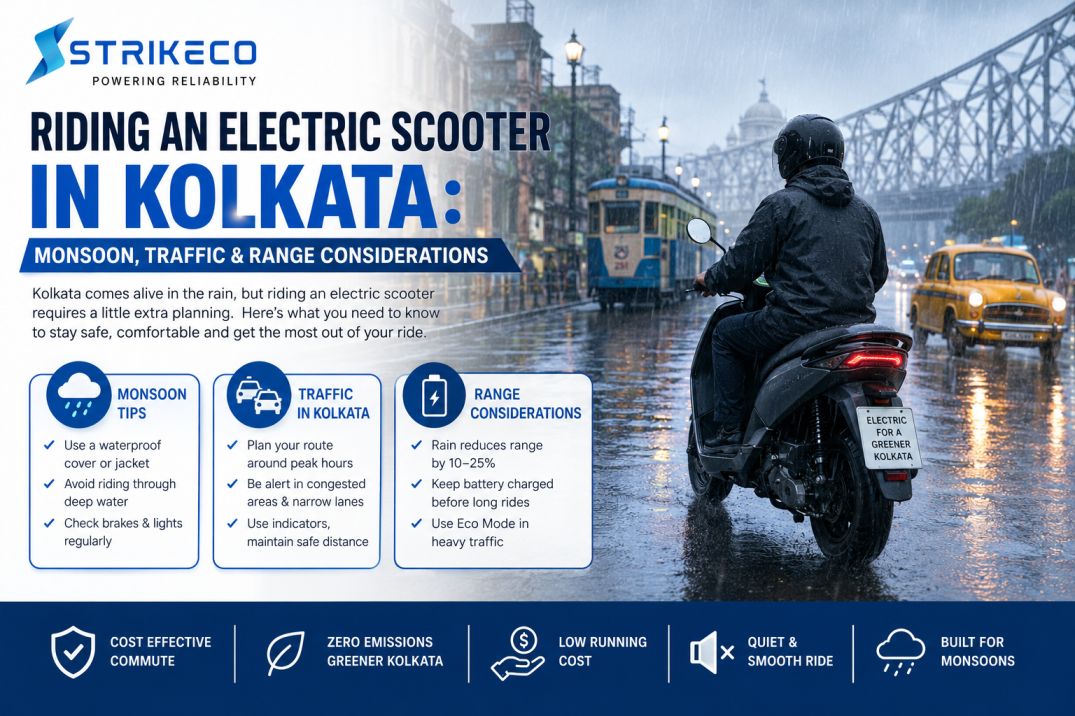
Electric scooters can be ridden in rain only within the conditions permitted by the manufacturer. Rain resistance does not mean a scooter can safely travel through deep water. During Kolkata’s monsoon, riders should reduce speed, increase braking distance, avoid waterlogged roads, and follow the manufacturer’s water-exposure and charging instructions.
The distinction between rain and waterlogging is critical.
An electric scooter may be designed to tolerate normal rain or road spray, but standing water can potentially reach components that would not normally be exposed during ordinary riding.
Water also creates conventional road-safety problems regardless of whether the vehicle is electric:
Reduced tyre grip: Wet surfaces increase the risk of skidding.
Longer stopping distance: Riders should brake progressively and leave more space.
Poor visibility: Heavy rainfall reduces the rider’s ability to see potholes, lane markings, vehicles and pedestrians.
Hidden road hazards: Water can hide potholes, damaged surfaces, open drains and debris.
Do not assume that an IP rating means the entire scooter can be submerged or ridden through unrestricted water depths. Check exactly which components have been tested and what the manufacturer states about permissible exposure.
How Should You Ride an Electric Scooter in Heavy Rain and Waterlogged Conditions?
During heavy rain, ride more slowly, avoid sudden acceleration or braking, keep greater distance from surrounding traffic, and avoid deep or unknown standing water. After significant water exposure, inspect the scooter before charging and follow the manufacturer’s instructions if the battery, charging connector or electrical components may have become wet.
For Kolkata monsoon riding, several habits are particularly useful.
Avoid riding directly into a large flooded section simply because another vehicle manages to cross it. A bus or combustion-engine motorcycle may have completely different ground clearance and water-exposure limits.
Slow down before painted road markings, metal covers, wet leaves and smooth surfaces, where traction can be lower.
After reaching your destination, inspect areas such as the charge port and visible electrical connectors. Never connect charging equipment where the plug, socket or charging area is wet.
If the scooter has been exposed to water above the manufacturer’s permitted level, avoid switching, opening, dismantling or charging the battery based on guesswork. Follow the manufacturer or authorised service procedure.
How Does Kolkata Traffic Affect Electric Scooter Range?
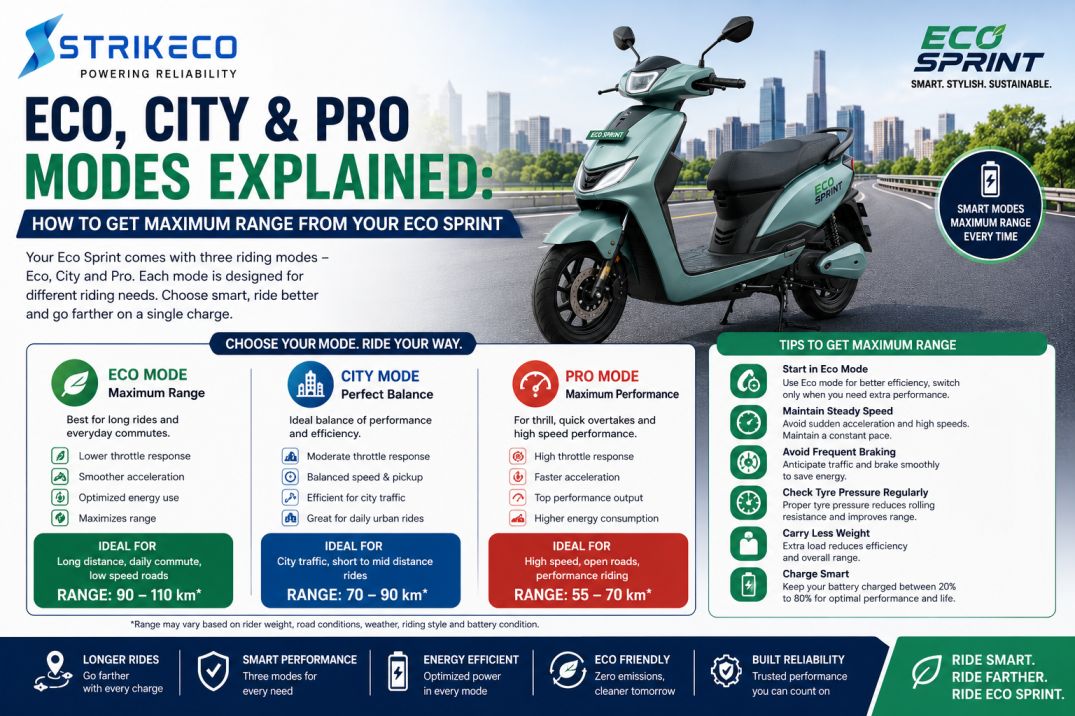
Kolkata’s congestion can change real-world energy consumption because city riding involves repeated acceleration, braking and variable speeds. Regenerative braking may recover some energy on scooters that support it, but repeated acceleration, heavy loads, aggressive riding and auxiliary electrical use can still reduce achievable range.
Kolkata is a highly congested city. TomTom’s 2025 data puts average congestion at 58.9%, while commuters lost an estimated 150 hours during rush-hour traffic over the year.
Electric drivetrains differ from petrol engines because electric motors can operate efficiently at low speed and some scooters recover energy during deceleration. That does not mean traffic has no effect on range.
Consider two riders covering the same 25 km:
Rider A accelerates gently, maintains moderate speed and anticipates traffic.
Rider B frequently accelerates hard between signals, brakes sharply and carries a heavier load.
Rider B can consume noticeably more battery even though both travel exactly the same distance.
Range should therefore be treated as an outcome of distance + speed + acceleration + load + terrain + weather + battery condition, rather than distance alone.
How Much Real-World Range Do You Need for Daily Commuting in Kolkata?
Choose an electric scooter whose realistic range comfortably exceeds your normal round-trip distance. Do not size the scooter so tightly that reaching home depends on achieving the maximum advertised range every day. A useful buffer accommodates traffic, battery aging, detours, weather, passenger weight and unexpected trips.
Suppose your commute is:
Home to office: 15 km
Office to home: 15 km
Your base requirement is 30 km per day.
But your actual riding might occasionally include:
5 km for shopping,
3 km for a diversion, and
2 km for another errand.
That produces a 40 km day.
Selecting a scooter whose real-world capability is only slightly above 40 km provides little flexibility.
A better approach is to identify your worst reasonably expected normal day and choose a scooter with meaningful remaining battery capacity after completing it.
For example:
Daily Round Trip
Practical Approach
10–15 km
Most modern commuter scooters may provide ample margin
20–30 km
Verify real-world rather than claimed range
30–50 km
Range buffer becomes increasingly important
50 km+
Battery capacity, charging access and real-world testing become major purchase criteria
These are planning guidelines, not fixed range requirements.
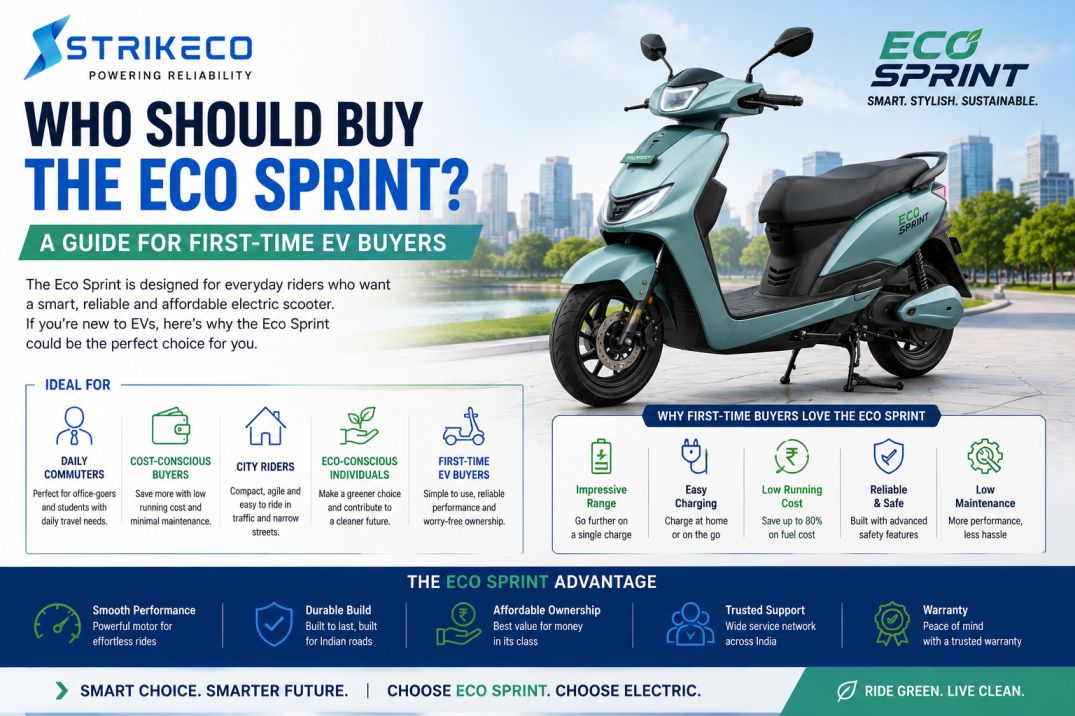
Buyers can compare available StrikeCo models such as the Cresta electric scooter, Verv electric scooter and Sprint electric scooter according to their individual specifications and commuting needs.
How Do Heat, Humidity, Rider Weight and Speed Affect Range?
Actual electric scooter range can change with temperature, battery condition, rider and passenger weight, speed, acceleration, tyre pressure, road conditions and auxiliary electrical consumption. Advertised range should therefore be treated as a reference measured under specified conditions rather than a guaranteed result for every Kolkata rider.
Rider and Passenger Weight
A heavier vehicle-plus-rider combination requires more energy during acceleration.
Someone carrying a passenger regularly should therefore avoid calculating range based only on solo riding.
Riding Speed
Energy consumption generally rises as speed increases, particularly because aerodynamic resistance becomes more important.
Maintaining moderate, steady speeds typically consumes less energy than frequent high-speed acceleration.
Stop-and-Go Traffic
Repeated acceleration consumes energy. Regenerative braking may recover some of it where available, but the recovery is not 100%.
Smooth throttle control is usually better for range than aggressive starts between signals.
Heat
Battery temperature affects lithium-ion battery performance and aging. High temperatures can increase battery stress, particularly if a scooter is repeatedly parked in strong sunlight or charged under unsuitable conditions.
Follow manufacturer recommendations concerning charging and storage temperature.
Humidity and Monsoon Conditions
Humidity itself does not translate into a fixed percentage reduction in range. However, monsoon riding can introduce additional factors such as slower speeds, wet-road resistance, diversions, congestion and electrical-system exposure.
Avoid websites or sellers promising an exact “monsoon range reduction” unless it is backed by testing for that particular scooter.
Tyre Pressure
Underinflated tyres increase rolling resistance, which can increase energy use.
Keeping tyres at the manufacturer-recommended pressure is a simple way to support predictable efficiency as well as handling.
What Should You Check About Battery Protection and Water Resistance?
For Kolkata conditions, buyers should verify battery enclosure protection, the manufacturer’s stated water-resistance rating, charging-port protection, battery-management functions, warranty exclusions related to water ingress, and the exact permitted riding conditions. Never interpret “water resistant” as “waterproof.”
Before purchasing, ask the dealer for specifics rather than accepting phrases such as “monsoon proof.”
Check:
Battery enclosure: How is the battery protected from road spray and rain?
IP rating: Is an ingress-protection rating specified, and does it apply to the battery, motor, controller or complete vehicle?
BMS: What protections does the battery-management system provide?
Warranty: Is water damage covered or excluded?
Ground clearance: How much clearance does the scooter provide?
Charging port: Does it have appropriate physical protection when closed?
User manual: What does the manufacturer actually recommend for riding in rain or after water exposure?
These details matter considerably more than a generic advertisement showing the scooter riding on a wet road.
What Should You Check About Brakes and Tyres?
Kolkata riders should evaluate wet-weather control alongside electric range.
For tyres, check tread condition, manufacturer-specified pressure, dimensions and replacement availability. Wider tyres alone do not automatically guarantee better wet grip; tyre compound and tread design also matter.
For braking, assess the scooter’s front and rear braking configuration and any combined or electronic braking features the model provides.
During a test ride, pay attention to controllability rather than simply asking how quickly the scooter stops. Smooth and predictable braking is particularly valuable in traffic where pedestrians, buses, autos and other vehicles can change direction unexpectedly.
What Should You Check About Charging for Daily Kolkata Use?
Charging convenience can be as important as battery range. Buyers should verify charging time, charger input requirements, removable versus fixed battery design, charging location, electrical socket quality and service support before purchasing an electric scooter.
Consider where you will actually charge.
If you live in an apartment, ask:
Can the scooter be charged in the parking area?
Is the battery removable?
Can you safely carry the battery to your flat if required?
Is a suitable electrical outlet available?
How long does a normal charge take?
Can charging be completed overnight?
During the monsoon, charging location becomes even more important. Chargers, extension connections and sockets should not be exposed to rain or standing water.
What Factors Should You Compare When Choosing an Electric Scooter for Kolkata?
A Kolkata commuter should compare the entire ownership experience, not just claimed range and purchase price.
Factor
Why It Matters in Kolkata
Real-world range
Determines whether daily travel has sufficient reserve
Battery capacity
Influences range and charging needs
Battery warranty
Important for long-term ownership
Water resistance
Relevant during monsoon
Ground clearance
Helpful on uneven and water-affected roads
Tyres
Important for wet-road grip
Brakes
Critical in dense stop-start traffic
Weight/load rating
Relevant for pillion use
Charging time
Affects everyday convenience
Removable battery
Useful where parking lacks charging
Service network
Important for maintenance and repairs
Spare-parts availability
Influences long-term usability
Storage space
Relevant for daily commuting
Warranty exclusions
Check battery and water-damage conditions
Before deciding, test ride the scooter in conditions that resemble your normal commute wherever possible.
You can also explore the StrikeCo electric scooter range and confirm model-specific specifications directly before choosing a scooter for your route.
A Practical Kolkata Electric Scooter Buying Example
Consider a commuter who travels from home to work and back for 32 km per day, normally carries a laptop bag and occasionally makes an additional 8 km trip.
Instead of choosing based on a theoretical 40 km requirement, the buyer should ask:
Does the scooter comfortably complete 40 km under realistic conditions?
What happens when a passenger is added?
How much range remains after the journey?
Will battery aging eventually make this route difficult?
Can the scooter be charged at home every night?
What are the rain and water-exposure limitations?
Does the service network support the location?
That produces a better purchasing decision than simply comparing which scooter claims the largest range figure.
Kolkata Electric Scooter Selection Checklist
Before buying, confirm that your normal and occasional daily kilometres are known, real-world range provides sufficient reserve, the battery and warranty terms are clear, water-resistance specifications are documented, tyres and brakes suit urban riding, ground clearance is adequate, charging is practical at home or work, and local service and replacement parts are accessible.
For riders interested in StrikeCo products, model-specific questions can be raised through the StrikeCo contact page rather than assuming specifications that may differ across scooters.
An electric scooter can make sense for daily commuting in Kolkata, but the city's traffic and monsoon conditions make practical selection especially important.
Kolkata’s 2025 average congestion level was 58.9%, with a 10 km journey averaging over 35 minutes and evening rush-hour journeys taking even longer. This makes low-speed urban usability, predictable range and comfortable stop-and-go operation important considerations.
For monsoon use, focus on manufacturer-approved water exposure rather than assuming every electric scooter is waterproof. Avoid deep water, maintain tyres and brakes properly, and never charge through wet connectors or in an unsafe wet environment.
For range, do not shop according to the exact distance you travel each day. Allow a meaningful buffer for traffic, weather, rider weight, detours, battery aging and operating conditions.
A practical buying sequence is:
Calculate daily distance → establish realistic range requirement → evaluate battery and charging → verify water resistance → check brakes and tyres → test urban usability → compare warranty, service and ownership cost.
For independent context on just how significant congestion can be for Kolkata commuters, the TomTom Kolkata Traffic Index provides current city-level traffic and travel-time data.
Frequently Asked Questions
Is an electric scooter good for Kolkata traffic?
Yes, it can be practical for short-to-medium urban commuting when its real-world range and charging arrangements fit the rider’s routine. Kolkata’s high congestion makes low-speed usability and stop-and-go comfort particularly relevant.
Can I ride an electric scooter in Kolkata rain?
Normal rain may be acceptable for a scooter designed and rated for it, but follow the specific manufacturer’s instructions. Water resistance should not be interpreted as permission to ride through deep or unknown waterlogging.
Can an electric scooter go through waterlogged roads?
It is better to avoid deep or unknown standing water. The safe water-exposure limit depends on the particular scooter, battery, motor and electrical components. Floodwater can also conceal potholes, drains and other hazards.
Does traffic reduce electric scooter range?
Traffic can change energy consumption. Repeated hard acceleration consumes more energy, while regenerative braking may recover some energy on equipped scooters. Actual range depends on the entire riding pattern.
How much extra range should I keep for my daily commute?
There is no universal percentage, but your scooter should comfortably exceed your normal round-trip requirement rather than reaching home nearly empty every day. Include extra distance for errands, diversions, passenger weight, aging and changing conditions.
Does rider weight affect electric scooter range?
Yes. Increasing the combined weight of the rider, passenger and luggage generally increases the energy required, particularly during acceleration and on inclines.
Is advertised electric scooter range the same as real-world range?
Not necessarily. Claimed range is measured under defined test conditions. Real-world results can vary with speed, load, acceleration, traffic, tyre pressure, temperature, road conditions and battery condition.
What is most important when buying an electric scooter for Kolkata?
Prioritize realistic range, reliable battery protection, water-resistance information, wet-weather braking and tyres, practical charging, ground clearance, warranty, after-sales service and suitability for your actual route.